

THE POWER OF AFRO-EUROPEAN SERENDIPITY
The unique blending ("métissage") of Africa and Europe, rolled out en masse, can lead to innovations that change the world. Chance and partnerships are the basis for global progress.

The birth of global innovation
Serendipity is the unexpected discovery of innovative products, services or policies with a global impact. This phenomenon can be accelerated by the massive historical and economic 'métissage' between Europe and Africa. Both continents often underestimate the power of chance finds, which arise from a shared history, cultural kinship and economic complementarity.
Serendipity in action: from penicillin to the ECSC
History is full of serendipity discoveries: products and services such as the steam engine, electricity, radiology, Fleming's penicillin, the microwave, post-its, the internet and even Viagra. On a political level, the creation of the ECSC by Minister Schumann in 1950 is a striking example: an initially immature idea that led to almost 80 years of peace and prosperity in Europe.


Synergy for a new world: economic and geopolitical opportunities
Population pyramid 2050
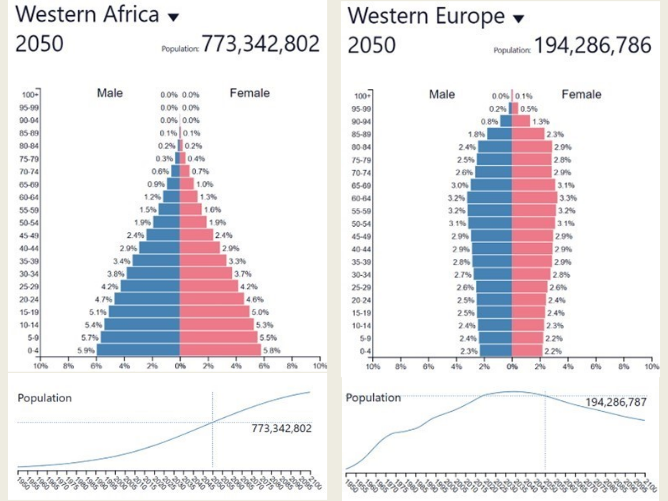
Africa's young, skilled population, the growing AfCFTA market, abundant raw materials (including 35% of the global green hydrogen potential) and frugal innovation perfectly complement Europe's expertise in complex industrial value chains.
The unique blend of African resilience and European experience opens the door to thousands of new, climate-friendly products and jobs, which are crucial for a sustainable future.
Geopolitically, an informal Afro-European partnership, representing 35% of the global workforce, can dominate global consultations on climate transition, conflicts, free trade and migration, and thus provide a counterweight to other major powers.
More details
THE POWER OF AFRO-EUROPEAN SERENDIPITY
Serendipity: the accidental discovery of innovative products and services with global reach
Serendipity as a result of a massive historical and economic 'blending' ('métissage')
The two continents, certainly Europe but also Africa, underestimate the serendipitarian power of their historical-cultural kinship and their economic complementarity. Serendipity is finding by chance new products, services or even innovative policies that are of global interest.
- Examples of serendipity products and services: steam engine, electricity, radiology, penicillin, microwave oven, post-it, internet, MS-DOS,... Viagra.
- An example of a fortuitous policy: would Schumann himself have believed at the time that his weakly conceived idea of an ECSC would lead to 80 years of peace and prosperity in Europe?
Afro-European economic complementarity
- Africa : its demographic dividend instructed in search of a prospect (also in LDCs, least developed countries), the AfCFTA, the world's largest free trade market, under construction, 35% of the world's green hydrogen production potential at €2/kg (Europe 1%), abundant raw material resources, 60% of the world's arable land, the world's second green lung, thousand "stable" regions, ..., its frugal innovation (achieving objectives with limited resources).
- Europe : its experience with hyper-complex global industrial value chains.
The opportunities of serendipity
- Socio-economic. The massive blending («métissage ») of knowledge, in the most diverse economic sectors, of the African market and its frugal productive experience, in cultural and physical proximity with the European experience of advanced industrial value chains between a thousand SMEs that look each other in the eye and understand each other, inevitably leads to serendipity; the fortuitous discovery of innovative, more climate-friendly and more recyclable products and services that the world needs. New products and services that create thousands, if not millions, of new jobs, certainly in Africa but also in Europe.
- Geopolitics. Europe, which will barely have 7% of the world's population in twenty years' time, needs to have a say on the world stage alongside China, the United States and an unstable Russia in nuclear matters. The West and China continue to exploit Africa by buying mineral resources at market prices that they determine themselves in order to add value and jobs. In doing so, the West and China are preventing Africa from gaining the experience necessary to – eventually – orchestrate global industrial value chains itself in order to locally process as much of its immense mineral resources as possible into exportable semi-finished/finished products and the creation of millions of formal jobs. If Europe takes the lead in being the first to stimulate industrial partnerships – of mutual interest – between established and experienced European SMEs and complementary African counterparts, there is a real chance that an informal Afro-European geopolitical partnership will also emerge – with 35% of the world's active population – conducting ad hoc consultations globally on topics that matter such as the climate transition, conflicts, free trade, needed changes in human behaviour and migration.
A guided shift in European mindsets
‘Jobs’ that is what Africa is concerned about
Europe must merit a partnership with Africa
Europe, an urgent need for an industrialised Africa
Energy Transition: a Tipping Point for More Justice in an Africa-Europe Partnership
Massive blending industrial know-how with Africa re-establishes Europe in turnmoil
An AU-EU Mandela-Schuman Community of Energy-Intensive Industries boosts world peace
Maak jouw eigen website met JouwWeb